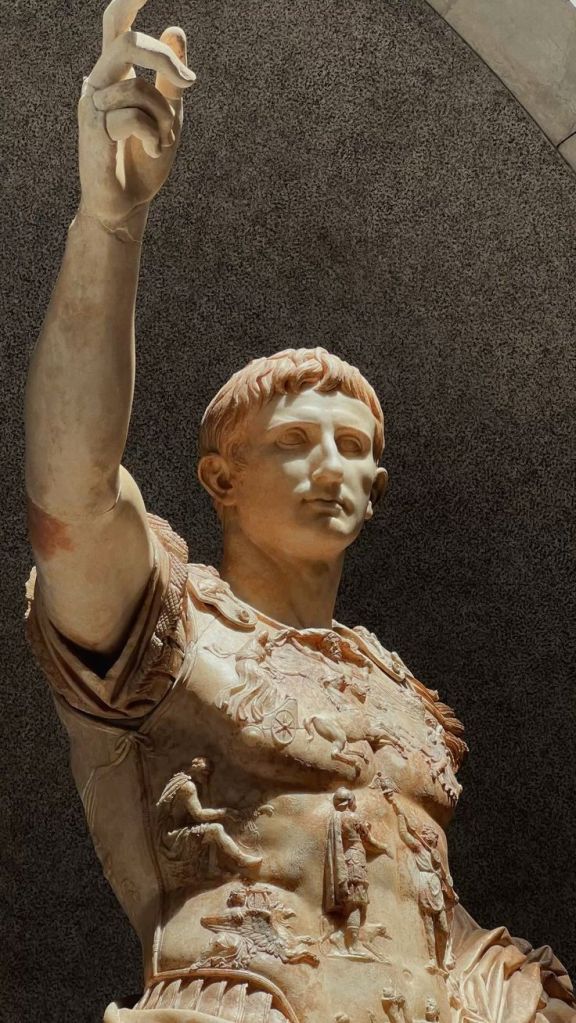
Image source: Pinterest
FUN FACT😮✨: The “Augustus of Primaporta” (the image shown above) is one of the most famous examples of ancient catfishing! An older emperor still needing to appear strong and capable to his people through statues, times never change huh?
In PR, we talk about image, how it forms, how it fractures, and how it’s rebuilt.
But long before brands fought for market share, one man perfected the art of reputation management:
Augustus.
Rome’s first emperor.
History’s quiet PR mastermind.
This isn’t a history lecture.
This is a lesson in strategic image-making, using Augustus as the case study.
🎭 Why Image Still Rules Everything
Brand image, as Išoraitė explains, is “the sum of beliefs, ideas, and impressions” held in the audience’s mind, not the brand’s own description of itself .
Park, Jaworski, and MacInnis add that successful brands maintain a “concept-image”: a cohesive identity that aligns with audience expectations and emotional needs .
In other words:
A brand is not what you say it is, it’s what people decide it is.
Augustus understood this intuitively.
🏛️ Augustus: A Rebrand in Real Time
After Rome’s civil wars, Augustus inherited a reputation drenched in violence.
He didn’t deny it, he rewrote it.
Pollok’s research shows how he used symbols, monuments, religious messaging, and cultural storytelling to cast himself as the bringer of stability and moral renewal, exactly what Rome wanted to believe after decades of chaos .
He turned his rise to power into a narrative of peace.
That is PR.
🪙 Consistency Is the Strategy
Park’s model stresses consistency across all touchpoints.
Augustus delivered.
Coins featured divine favor and youthful strength.
Statues portrayed calm authority.
Architecture embodied order and continuity.
Wallace-Hadrill’s analysis of Augustan coinage reveals how even currency served as brand collateral, reinforcing legitimacy with every transaction in the empire .
He made his message inescapable, but not aggressive.
Subtle repetition did the work.
🔥 Reframing Crisis, Not Hiding It
Augustus’ rise was violent. Everyone knew it.
Instead of burying that narrative, he transformed it:
- The wars became a necessary step toward peace.
- His power became a protective duty.
- His rule, a restoration, not a takeover.
He turned a legitimacy crisis into a redemption arc.
Modern PR uses the same play:
own the narrative before the narrative owns you.
💡 What We Should Learn From Him
Here’s the takeaway for PR practitioners:
1. Lead with the story your audience needs.
Augustus sold stability, not supremacy.
2. Stay visually and emotionally consistent.
Identity works when every touchpoint repeats the same message.
3. Reframe the crisis, don’t run from it.
Control the interpretation, and you control the memory.
4. People follow feelings, not logic.
Rome didn’t analyze Augustus, it trusted him.
Tools evolve.
Human psychology does not.
💬 Your Turn
Which figure, ancient or modern, do you think pulled off the best reinvention?
And who should I break down next: Nero, Caligula, Antony?
Comment below, let’s keep the series going. 🏛️✨
 Maria's PR Tips
Leave a comment